 Peers Best
PBAG Community Theatre · Ithaka cia Kamĩrĩĩthũ — created by Boni Kanyuira · produced by Samuel Gitonga · head writer Mwaniki Njache · Historical research: PBAG with TovuTech ·
A flat place where the water never dries
Ithaka is land — not land as a title deed, but land as lineage: the soil your grandmother cleared, the ridge your clan defended, the grave that tells you who you are. Kamĩrĩĩthũ takes its name from mirithu, a flat place on which rests a pool of water defiant to drought. It sits on the cool roof of Limuru, about 2,500 metres up on the eastern lip of the Great Rift Valley, between the Narok road, the Limuru–Mutarakwa road and today's Nairobi–Nakuru highway.
Every ridge here has two histories: the one written in colonial files, and the one carried in songs, names and graves. This story tries to hold both — and it is the soil from which PBAG Community Theatre's new production grows.
In the beginning: Gĩkũyũ, Mũmbi and the nine daughters
The Agĩkũyũ tell that Ngai — the Divider, the Giver — took Gĩkũyũ to the summit of Kĩrĩnyaga (Mount Kenya) and showed him the land below: ridges, rivers and forest. At its heart stood a grove of fig trees, and there, at Mũkũrwe wa Nyagathanga in today's Murang'a, Gĩkũyũ was told to build his home. Ngai gave him a wife, Mũmbi — "the one who moulds, who creates".
They had daughters — nine of them by the most common telling — and from these daughters came the clans (mĩhĩrĩga) that still organise kinship among the Agĩkũyũ. A tenth, Wamũyũ (or Warigia), appears in some versions.
Spellings and pairings vary between families and regions; the list follows the common published version. This is sacred tradition, told here with respect.
Ridges, forests and the stone of fear

Long before fences, the southern Kikuyu frontier was moving land. Families pushed into the forests of what became Kiambu, clearing ground and founding mbari — lineage estates whose boundaries were remembered by elders rather than surveyors. To the north-west, the grassy country the Maasai called Lari, "the place of green grass", served as dry-season grazing.
The landscape held its own institutions. In Ndeiya, below Limuru, a rock leans over a cliff: Ihiga rĩa Gũoya, the Stone of Fear. Local tradition remembers it as a place where boys became men; nearby stands Ihiga rĩa Nyondo. Today hikers climb there for the view across the plains — few know they are walking an initiation path.
Strangers on the ridge
- 1890Captain Frederick Lugard of the Imperial British East Africa Company camps on the land of Waiyaki wa Hinga near Dagoretti and builds a fort.
- 1891Company porters loot farms; Waiyaki's warriors raze the garrison. Kinyanjui wa Gathirimu helps the company men withdraw — and is later rewarded.
- Aug 1892At "peace talks" at Fort Smith, Waiyaki is wounded and arrested near today's Kabete Police Station. He dies on the road to the coast, at Kibwezi.
- c. 1900The Uganda Railway climbs past Limuru toward the Rift. Settlers follow — drawn by fertile soil, cool weather and a short ride to Nairobi.
- 1903Tea is planted at Limuru — the beginning of Kenya's tea industry. The ridge becomes part of the "White Highlands".
- 1930St Paul's Divinity School moves to Limuru. Mission, estate and railway now frame Kikuyu life on the ridge.

The chiefs: resisters, allies and those caught between
The British ruled through appointed chiefs. Some were elders with real standing; others were the Company's men. Their choices — to resist, to accommodate, to collaborate, or to petition from inside — shaped who kept their land. History rarely sorts them neatly; this dossier sets out what the records say.

Waiyaki wa Hinga
Dagoretti · d. 1892Mũthamaki of southern Kikuyu country. Treated with Lugard, then fought the Company when its garrison abused his people. Arrested at Fort Smith in 1892 and killed at Kibwezi. Waiyaki Way in Nairobi bears his name.
Kinyanjui wa Gathirimu
Dagoretti · Kabete · c. 1865–1929Company porter and interpreter who became its close ally — led punitive raids, sold southern Kiambu land to early settlers from 1902, and was made the only Kikuyu paramount chief. Died at Thogoto in 1929.
Koinange wa Mbiyu
Kiambaa · c. 1865–1960Senior Chief of Kiambu from 1938. Opposed land alienation and campaigned for Africans' right to grow coffee. Detained in 1952 at about 87; released on 1 July 1960, he died 19 days later.
Waruhiu wa Kung'u
Ruiru · Githunguri · d. 1952Senior chief who publicly condemned Mau Mau. Shot near Gachie on 7 October 1952; within two weeks the colony was under a State of Emergency.
Luka wa Kahangara
Kirenga, Lari · d. 1953Removed from Tigoni with his people, he had worked as a settler's farm supervisor before becoming chief at Kirenga. Killed with members of his family on the night of 26 March 1953 — the Lari Massacre.
Ikenya Charles & Makimei wa Kuria
Bathi · Gituamba (Lari)Also targeted on 26 March 1953. Both escaped; their property was burned.
Josiah Njonjo & Njiiri wa Karanja
Kikuyu Association · 1919With Koinange and Waruhiu, founded the Kikuyu Association to carry grievances to the colonial government through official channels.
Chief Kamiri & Chief Jairus
KamĩrĩĩthũNamed in local records as chiefs associated with Kamĩrĩĩthũ. Their full stories are part of PBAG's ongoing oral-history gathering.
Ex-Chief Mũkoma wa Njiriiri
Kiambu / Limuru · colonial eraA prominent colonial-era chief of the Kiambu–Limuru area, remembered in full as Ex-Chief Mũkoma wa Njiriiri. He served as a chief under British rule in the Kiambu/Limuru region.
A contested tenure. Robert L. Tignor's The Colonial Transformation of Kenya: The Kamba, Kikuyu, and Maasai from 1900 to 1939 (Princeton, 1976) notes that the colonial government recorded heavy emigration from Chief Mũkoma's location, attributing it directly to the "petty oppression" that existed under his rule — a reminder that the chief system often pushed families off their land as surely as settlers did.
His life in print. His history, life and times are explored in the biographical book Ex-Chief Mũkoma wa Njiriiri by Mbũrũ wa Njiriiri.
Context: the seer Mugo wa Kibiru foretold the coming of the strangers and the "iron snake" railway; tradition holds he prophesied that a great mũgumo at Thika would wither at independence.
Add family recordsFrom Tigoni to Lari: the wound in the land
In the 1930s the colonial Land Commission weighed Kikuyu claims to the ridges around Limuru. In 1939 families were moved off Tigoni so that settlers could plant coffee and tea: members of ten mbari and their tenants were relocated — Tigoni people to Kimende, Githirioni and Kirenga in Lari, Kiambu people to Bathi. At first they were not compensated.
“The Lari Massacre had its origins in the early 1900s.”— J. G. Kiereini, A Daunting Journey, as quoted in Business Daily
Among those moved was a man named Luka, who worked as a supervisor on a settler farm and later became chief of Kirenga. In Lari, the question of who had been given land, and who had lost it, set neighbour against neighbour. When the Emergency came, settlers in Tigoni formed their own militia — the "Tigoni Tigers", an offshoot of the Limuru Farmers Association.
Fire on the ridge

On 20 October 1952 the Governor declared a State of Emergency. The Kenya Land and Freedom Army — Mau Mau — took to the forests: Kereita, Kinale, Ragia and on into the Aberdares. Caves in Kereita and Ragia still mark where fighters sheltered.
On the night of 26 March 1953, fighters attacked loyalist homesteads at Lari. Huts were set alight; families were cut down as they fled. Chief Luka and thirteen members of his family died. Historians commonly cite about 74 dead; other accounts give higher figures. The colonial government showed the scene to journalists to make its case to the world — and its forces and the Home Guard then went door to door. Reprisals killed about 400 people by some estimates, and survivors' accounts suggest far more. Of 309 people prosecuted, 136 were convicted and 71 hanged. Many of the dead lie in a mass grave in Kereita Forest.
Lari shows the Emergency as it was lived: not only settlers against Africans, but a civil war among neighbours over land, loyalty and fear.


In 1955 Kamĩrĩĩthũ itself was burned and its people herded into an Emergency village behind trenches and guard posts — the village that became today's Kamĩrĩĩthũ. In one Kamĩrĩĩthũ household a half-brother, Mwangi, joined the forest fighters and was killed; another brother was shot; the mother was tortured at the Kamĩrĩĩthũ Home Guard post. A schoolboy in that household would one day write it all down.
The son of Kamĩrĩĩthũ

Ngũgĩ wa Thiong'o was born in Kamĩrĩĩthũ on 5 January 1938. He left Limuru for Alliance High School in 1955, in the middle of the Emergency, and went on to Makerere and Leeds. His novels — Weep Not, Child (1964), The River Between (1965), A Grain of Wheat (1967), Petals of Blood (1977) — carried the ridges of Limuru to the world.
Then he came home. In 1976 villagers founded the Kamĩrĩĩthũ Community Education and Cultural Centre. With Ngũgĩ wa Mĩriĩ they wrote Ngaahika Ndeenda (I Will Marry When I Want), in Gĩkũyũ, performed by workers and peasants in an open-air theatre they built themselves. It opened on 2 October 1977 before more than 10,000 people.
- Nov 1977The centre's public-performance licence is withdrawn.
- 31 Dec 1977Ngũgĩ is arrested and held without trial at Kamiti Maximum Security Prison, where he writes Caitaani Mũtharaba-inĩ (Devil on the Cross) in Gĩkũyũ.
- Dec 1978Released; he will later go into exile.
- 11 Mar 1982All theatre activity at Kamĩrĩĩthũ is banned while Maitũ Njugĩra (Mother, Sing for Me) is in rehearsal.
- 12 Mar 1982Three truckloads of armed police raze the open-air theatre.
- 28 May 2025Ngũgĩ dies in Buford, Georgia, USA, aged 87.
A village stage was demolished because people were telling their own story, in their own language, about their own land. That is the inheritance PBAG — born in Limuru in 2011 — carries onto the stage.
The land itself: ridges, forests, waters and sacred trees
Limuru sits on the cool, rain-fed roof of Kiambu, about 2,500 metres up, where the highlands break suddenly into the Great Rift Valley. Its soils grow tea and dairy; its forests fed the Mau Mau; its swamps feed Nairobi's rivers.
The Rift Valley escarpment
From the viewpoint on the Limuru–Mai Mahiu road the land drops into the Rift — with Mount Longonot's crater on the horizon.
Map ↗Forests of Lari & the Aberdares
Kereita, Kinale, Gatamaiyu, Uplands and Kamae — montane forest on the windward side of the Aberdares, now Important Bird Areas and Mau Mau heritage sites.
Map ↗Caves
The caves of Kereita and Ragia sheltered fighters during the Emergency; today guides lead walks past the caves to the Gatamaiyu waterfall.
Map ↗Tea country
Planted from 1903, Limuru's tea founded Kenya's tea industry. At Kiambethu, A. B. McDonell bought 350 acres in Tigoni in 1910; the farm still welcomes visitors.
Map ↗Dams, swamps & springs
Manguo Swamp beside Kamĩrĩĩthũ; Ondiri, Kenya's only known quaking bog, which recharges the Kikuyu Springs; farm dams such as Redhill's; and Sasumua Dam, gateway to Ragia.
Map ↗The mũgumo — sacred fig
Elders met Ngai beneath the mũgumo; prayers for rain and fertility were made there, and its timber is still not cut. Its fall is read as a sign of great change.
Read ↑Ihiga rĩa Gũoya
The Stone of Fear above the Ndeiya plains — an initiation landmark and now a hiking trail with sweeping views.
Map ↗Plains & grazing grounds
Lari — "the place of green grass" in Maa — and the Ndeiya plains, once dry-season grazing for Maasai herds.
Map ↗Know a notable mũgumo, cave, spring or dam we should add? Tell PBAG — the Heritage Atlas grows with the community.
Historic sites of Limuru & Lari
Now the land speaks — on stage
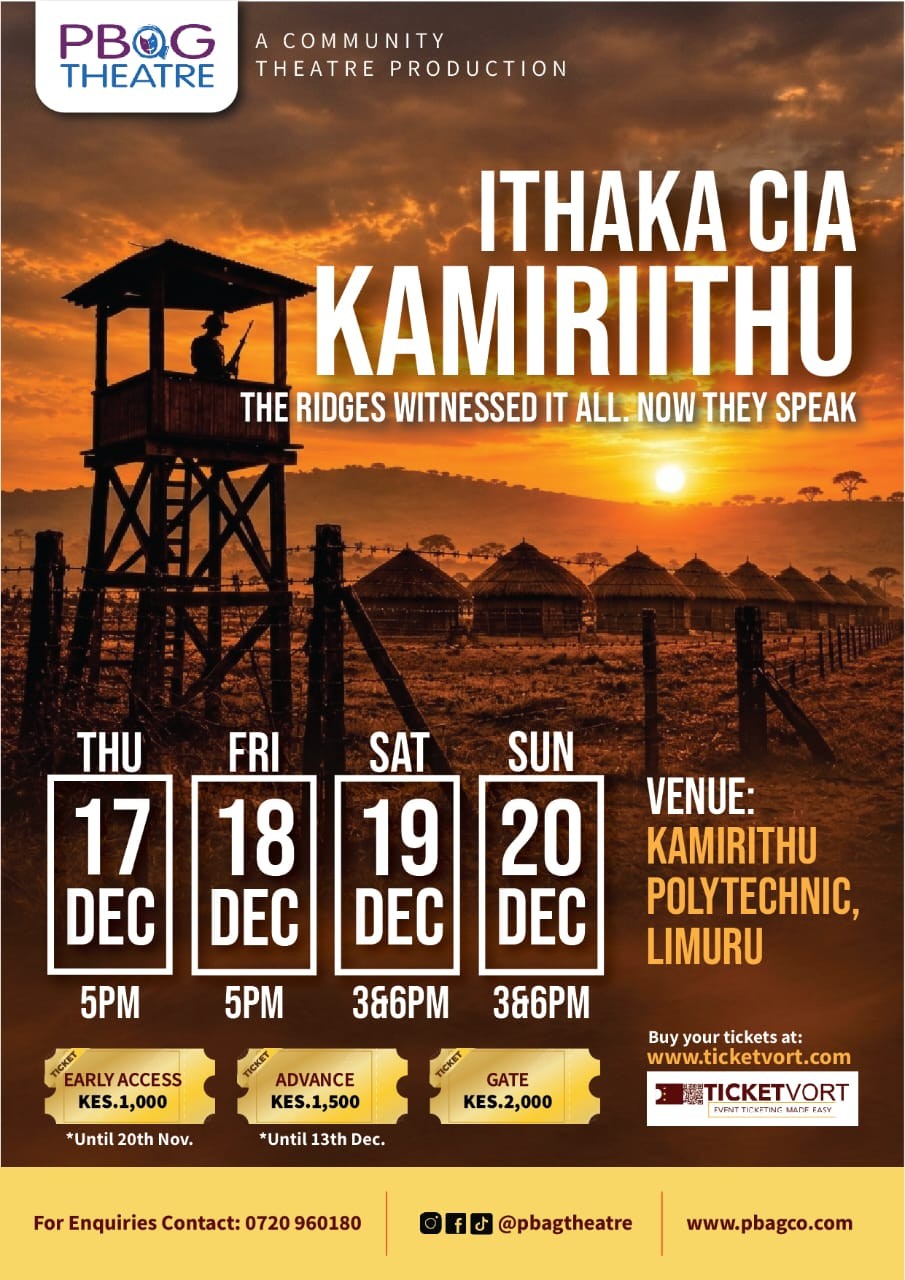
PBAG Community Theatre's Ithaka cia Kamĩrĩĩthũ brings this inheritance to the stage — performed at Kamĩrĩĩthũ itself and rooted in the community-theatre tradition that Limuru gave Kenya.
- Boni KanyuiraCreator
- Samuel GitongaProducer
- Mwaniki NjacheHead Writer
- Theatre born from the soil it stands on — Limuru artists telling Limuru's story.
- History you can feel — creation, land, chiefs, the forest and the village stage.
- Song, dance and Gĩkũyũ in the open-theatre spirit of Kamĩrĩĩthũ.
- For families and schools — a living lesson on the land question and on Ngũgĩ's legacy.
- Every ticket backs young artists in Limuru through PBAG.
Show details
- Kamirithu Polytechnic, Limuru
- Thu 17, Fri 18, Sat 19 & Sun 20 December 2026
- Thursday & Friday 5pm · Saturday & Sunday 3pm and 6pm
- Enquiries: 0720 960 180 · @pbagtheatre
| Early Access | KES 1,000 | until 20 Nov |
|---|---|---|
| Advance | KES 1,500 | until 13 Dec |
| Gate | KES 2,000 | at the venue |
Tickets are sold online by our ticketing partner, Ticketvort.
Performances
Loading dates…
How this story was researched
Compiled from published histories and journalism, cross-checked where accounts differ. Casualty figures for Lari vary widely between sources; we give the commonly cited figures and say so. Oral traditions are presented as tradition. Corrections and family records are welcome — this is a living file.
- Kamirithu · Kamĩrĩĩthũ Community Education & Cultural Centre · Limuru — Wikipedia
- Mũmbi — Wikipedia (Gĩkũyũ origin tradition and clan names)
- Lari massacre — Wikipedia, citing D. Anderson, Histories of the Hanged (2005) and C. Elkins, Imperial Reckoning (2005)
- The massacre 58 years ago today that still divides Lari — Daily Nation (2011)
- How colonists set the stage for Lari Massacre — Business Daily
- Kinyanjui wa Gathirimu · Koinange wa Mbiyu · Assassination of Waruhiu — Wikipedia
- Waiyaki wa Hinga — Ukombozi Review · Senior Chief Koinange vs Senior Chief Waruhiu — Hinges of Time
- Lari Constituency · Kereita — Wikipedia · Hiking Ragia — The Star
- Ihiga ria Guoya — Let's Drift
- Ngũgĩ wa Thiong'o · Mugo wa Kibiru — Wikipedia
- R. L. Tignor, The Colonial Transformation of Kenya (Princeton, 1976) · Mbũrũ wa Njiriiri, Ex-Chief Mũkoma wa Njiriiri
- Why the mugumo is sacred — People Daily · Ondiri, Kenya's only quaking bog — Daily Nation · Tigoni — Business Daily
- Map data © OpenStreetMap contributors. Images via Wikimedia Commons under the licences shown.